Short Guide To Writing About Film
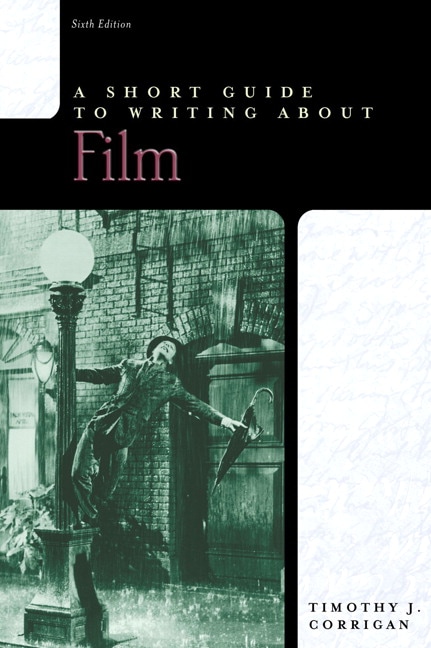
This best-selling text is a succinct guide to thinking critically and writing precisely about film. Both an introduction to film study and a practical writing guide, this brief text introduces students to major film theories as well as film terminology, enabling them to write more thoughtfully and critically. With numerous student and professional examples, this engaging and practical guide progresses from taking notes and writing first drafts to creating polished essays and comprehensive research projects.
Moving from movie reviews to theoretical and critical essays, the text demonstrates how an analysis of a film can become more subtle and rigorous as part of a compositional process. Table of Contents.
One of the more frequent jobs a university professor performs is text review, and it was in this role that I first read Corrigan's Short Guide. It's been around for some time, and I've noticed that students have decidedly mixed responses to it. My responses are mixed as well. It is true that Corrigan tends to wax a bit loquacious, letting wordy and meandering discussion often obscure the really important things he has to say. But speaking as a professor who teaches film courses and requires stud One of the more frequent jobs a university professor performs is text review, and it was in this role that I first read Corrigan's Short Guide.
It's been around for some time, and I've noticed that students have decidedly mixed responses to it. My responses are mixed as well.
It is true that Corrigan tends to wax a bit loquacious, letting wordy and meandering discussion often obscure the really important things he has to say. But speaking as a professor who teaches film courses and requires students to write critical essays about film, I must say that to date this is one of the best books on the market to address specifically the subject of writing about film (I think the best book is Tim Bywater's 'Introduction to Film Criticism'-which, unfortunately, is also a ridiculously over-priced Longman title). But it bears noting that there simply aren't many books available which do address this specific subject, so my praise has to be understood in that context.
And it's a shame that the book is priced over $40, which is a lot of money for a thin, 196 page paperback with some arguably serious flaws. Two stars might be rather unfair to this book. It is probably better than two stars - for someone else. But I did not think this book really taught me anything I did not already know. The questions it gives to help people analyze a film would be useful to someone without any real experience with analyzing and writing about film, so I guess the book does just what it intends to do: teach you how to write about film. To the book's credit, it is clearly written and the pictures are nice (and I do l Two stars might be rather unfair to this book. It is probably better than two stars - for someone else.
Short Guide To Writing About Film 9th Ebook
But I did not think this book really taught me anything I did not already know. The questions it gives to help people analyze a film would be useful to someone without any real experience with analyzing and writing about film, so I guess the book does just what it intends to do: teach you how to write about film. To the book's credit, it is clearly written and the pictures are nice (and I do like having good pictures). So those were pluses.
I do not know what I was hoping for with this book, but I guess I wanted more than it set out to give, which probably shouldn't be considered a fault in the book, since it sets out to do a certain task and does that task efficiently. Still, I hoped for more. Corrigan's approach is very enjoyable in his initial focus on the approach one makes to viewing a film, and how that really sets up the rest of your approach to writing an essay about films. I think in some instances his examples or the filmmakers he uses are probably a bit obscure for the type of class that a book like this is most likely to be used in, but this isn't necessarily a bad thing, either, as it forces one to expand their horizons even as they read through this simple guide. He also Corrigan's approach is very enjoyable in his initial focus on the approach one makes to viewing a film, and how that really sets up the rest of your approach to writing an essay about films. I think in some instances his examples or the filmmakers he uses are probably a bit obscure for the type of class that a book like this is most likely to be used in, but this isn't necessarily a bad thing, either, as it forces one to expand their horizons even as they read through this simple guide. He also addresses one thing that few writing guides that I've read have really talked about, namely issues of style at the level of the sentence.
He talks about varying sentence length, but then gives strategies for editing these problems out, and also addresses the tendency of some people to be excessively report-like in their writing, which is a personal pet peeve of mine. All around a very informative and useful read, even in the graduate context that I'm reading it in. Sure to be of even more help for undergraduate students and the average reader interested in doing some more work in and around film and film studies. Though I hold a bachelor of arts degree earned in the field of history, and the skills I honed in the course of those studies are applicable to other fields, I've been self-conscious for awhile now about writing about film. (I contribute to the blog for the movie ranking website Flickchart.) I'd seen copies of different editions of this book at Half Price Books for awhile, but kept resisting the purchase. After all, who was I kidding?
I'm not a real critic. Finally, though, on New Year's Eve, I g Though I hold a bachelor of arts degree earned in the field of history, and the skills I honed in the course of those studies are applicable to other fields, I've been self-conscious for awhile now about writing about film. (I contribute to the blog for the movie ranking website Flickchart.) I'd seen copies of different editions of this book at Half Price Books for awhile, but kept resisting the purchase.
After all, who was I kidding? I'm not a real critic. Finally, though, on New Year's Eve, I gave in and bought a copy.
If you're going to do something, you may as well learn to do it well, and the truth is, I like writing about movies. This Short Guide seemed a handy starting place for improvement.
The chief con is that it's addressed to freshman film students. The entire last chapter is dedicated to manuscript form and issues of margins and spacing, etc. I'm well past that point in my development, so being told that it's okay to make certain assumptions about what my instructor knows as I write my paper made me feel a bit silly.
Although, in fairness, if I was a freshman film student, I probably would have found the book engaging and encouraging, and I certainly would have appreciated author Timothy J. Corrigan for not trying to intimidate me.
Though I didn't learn anything groundbreaking, I did find the book generally helpful for organizing concepts already familiar to me into film language. I know, for instance, that of the four approaches to writing about film, it's the Theoretical Essay that I want to write more regularly - because that's the kind I most enjoy reading.
I'm uncomfortable with Movie Reviews, though I've written a handful of them. In 2012, I reviewed Brave for Flickchart after attending a preview screening, and I found that I had a difficult time really figuring out just how strongly I felt about its pros and cons. That led me to ending my review by including a section of how that movie entered my Flickchart, walking the reader through a series of head-to-head matches that allowed me to comment on the merits and how appealing they were of both films. I really dig that section, and it instantly became a staple of all my reviews for Flickchart as well as all my personal movie watching diary entries on Letterboxd. I feel that section gives the reader a whole lot more context for both the review and reviewer than is typically found in movie reviews. Perhaps the most important thing I'll take from A Short Guide to Writing About Film is Chapter 3's discussion about relating film to the other arts.
I'm used to discussing the relationship between movies and books, where the former is based on the latter. As a writer, I've primarily focused on elements like plot, character, and dialog. Though film is a visual medium (duh), I've given little consideration to the influence of visual arts. The section on 'Composition and the Image' in Chapter 3 covered a lot of things that have been so obvious that I've forgotten to really pay them much regard. Recently, I've re-watched a handful of early animated Disney feature films ( Bambi, Dumbo, Pinocchio). I was captivated by the artwork in all of them, the likes of which we will probably never see again in a movie.
Just look at that scene in Pinocchio of Gepetto's cuckoo clocks. That sequence is astounding. It also helped me to remember to pay greater attention not just to animated features, but to all films, and the composition of what's on screen: both the elements themselves, and the reasoning for their specific presentation. If nothing else, reading that small section of Chapter 3 justified my purchase. This short little book functions both as a guide to writing and an introduction to the study of film.
I imagine that the usefulness of this guide depends very heavily on the reader's former experience with writing critically (about film). This was not the right book for me - I'm already familiar with most of the ideas presented by Corrigan - but I believe this would be an excellent introduction for students just beginning to study film in university, especially because it explores the qualities This short little book functions both as a guide to writing and an introduction to the study of film. I imagine that the usefulness of this guide depends very heavily on the reader's former experience with writing critically (about film). This was not the right book for me - I'm already familiar with most of the ideas presented by Corrigan - but I believe this would be an excellent introduction for students just beginning to study film in university, especially because it explores the qualities or good writing as well.